
Description
DESCRIPTION FOR BOYS (ages 10-16):
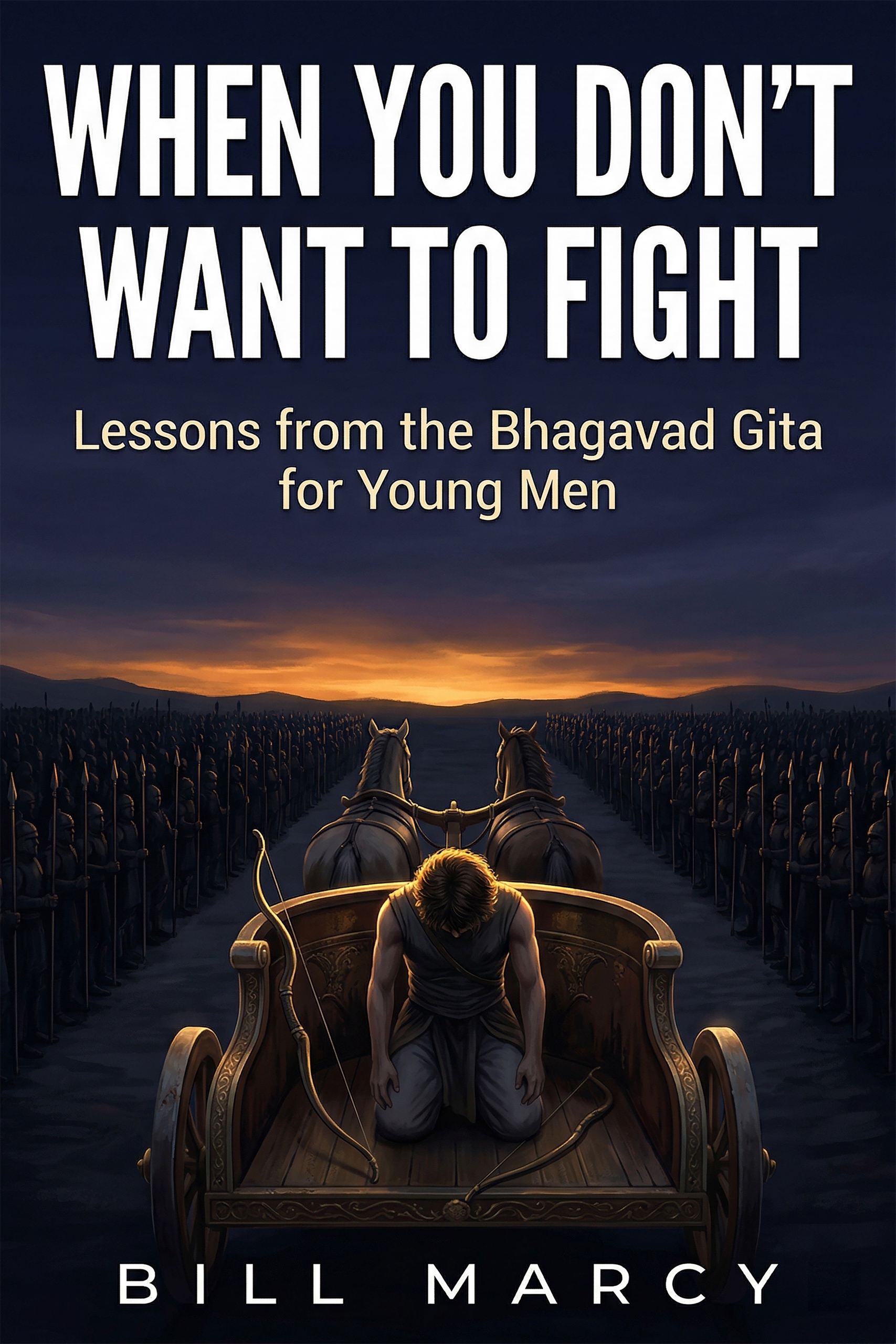
The greatest warrior in the ancient world is standing between two armies. The battle is about to begin. His enemies are his own family. His grandfather is on the other side. His teacher is lined up against him. He drops his bow, sits down in his chariot, and says: I won’t fight.
His charioteer looks at him and says: Get up.
The next 700 verses are the conversation that followed. It changed how hundreds of millions of people think about duty, action, courage, and what it means to do the right thing when every option costs you something.
When You Don’t Want to Fight takes the Bhagavad Gita, the most sacred text in Hinduism, and strips it to the ideas that hit a young man where he lives. Not a religion class. Not an Eastern philosophy lecture. A conversation between a teacher and a student at the hardest moment of the student’s life, about the questions you can’t avoid no matter how hard you try.
What your duty is and why avoiding it is worse than doing it. How to give everything to the work without being destroyed by the result. Why doing nothing is itself a choice, and usually the worst one. How to stay level when success pulls you to the ceiling and failure pushes you to the floor. Why the hardest fights are the ones you don’t want to have and why those are the fights that make you.
Every chapter ends with a PUT IT TO WORK section. Not a meditation. Not a mantra. A question about your life that only you can answer.
Arjuna picked up his bow. The question is whether you’ll pick up yours.
DESCRIPTION FOR PARENTS / GIFT BUYERS:
The Bhagavad Gita is a 700-verse conversation between a warrior who doesn’t want to fight and a teacher who won’t let him walk away. It is the most revered text in Hinduism and one of the most influential spiritual documents in human history. Gandhi called it his eternal mother. Thoreau, Emerson, and Oppenheimer were shaped by it. It has been translated into every major language on Earth.
When You Don’t Want to Fight makes this conversation accessible to a 10 to 16-year-old boy. Not as theology. Not as comparative religion. As the most intense mentorship session ever recorded, applied to the moral situations a young man actually faces.
Dharma and the duty that belongs specifically to him. Karma yoga and the practice of full effort without attachment to outcomes. The three gunas and how to identify which internal force is driving him at any moment. The difference between the field and the knower, between what happens to him and who he actually is. The teaching that inaction is itself a choice and often the most destructive one. Equanimity, the ability to stay level through success and failure alike.
Every chapter ends with a concrete question he can apply to his own life. This book connects naturally to the Stoic, Aristotelian, and Kantian teachings elsewhere in the series, while offering a perspective rooted in a completely different civilization. The convergence between these traditions, arrived at independently, is itself a powerful lesson: these truths about human character appear wherever humans look honestly at themselves.
If you want your son to encounter one of the deepest teachings on duty, action, and courage ever written, delivered through a story so dramatic it could be a movie, this is the book.




Reviews
There are no reviews yet.